Showing posts with label Double-crested Cormorant. Show all posts

Friday, March 15, 2013

Coming & Going

Traffic at Click Ponds can be quite minimal at times. A handful of common herons and egrets and Coots are always a guarantee  Yet, I find myself  there each week as it's quiet and peaceful and there's always a chance of finding something out of the ordinary. For the past two weeks, though, the ponds have been packed; I've probably seen more species in these past two weeks than I have over the past two years.


The White Pelicans have definitely been a highlight for me. With the ponds being so small, I've had a chance to watch these huge birds in action at close range. These migrating groups are most likely passing through as they make their way north. The first day I saw about 35 of them, a few mornings later there were over 150. By that same afternoon, they were just about gone. I arrived early on this past Sunday morning to find just this low key trio. I did wonder why they didn't leave with the large group.


No sooner did I look up to see a new group arriving. They flew past me to the west.


Then made the turn back towards the ponds...


and down they came.


I often saw the pelicans paired up with their fishing partners, Double-crested Cormorants. Check out the size difference in the bills of these two species below.


I'm pretty sure the White Pelicans wiped the ponds clean of all fish!


Many different species of ducks have also stopped by.

Mottled Duck and ducklings

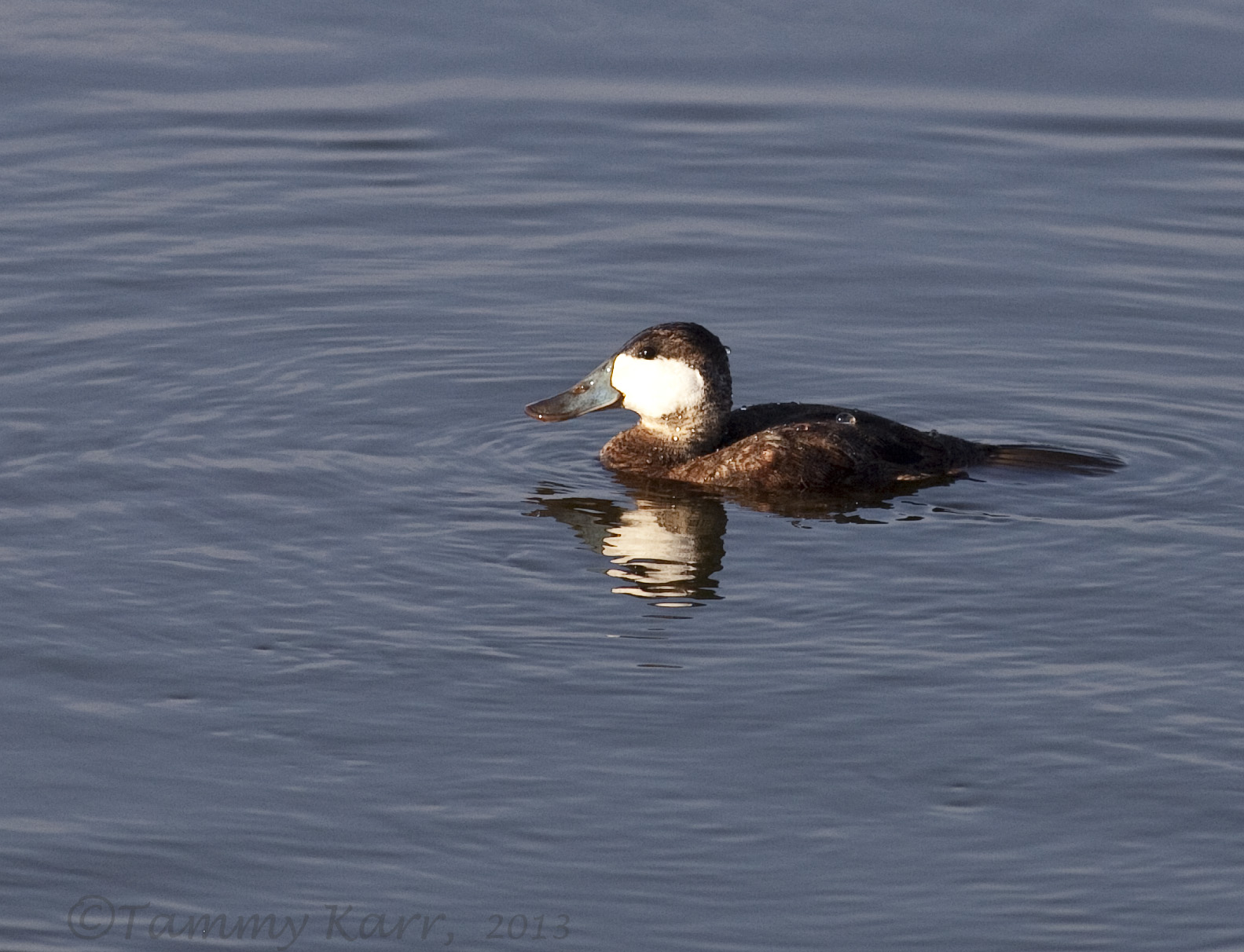
male Ruddy Duck

Ring-necked Duck

American Wigeon pair & Coot

Killdeer

The lower water levels have attracted some long legged friends.

Black-necked Stilt & Lesser Yellowlegs

Thanks to this Stilt I was able to see just how shallow these ponds are.


There was even a pair of Bonaparte's Gulls hanging around. They seemed to be struggling to "fit in". They first to try to join this group of ducks, but that didn't go so well. Where did everyone go? Was it something we said??

Bonaparte's Gulls

The gulls thought maybe they would fit in better with the pelicans.


Many species are now displaying their breeding plumage.

Great Egret in breeding plumage

Tricolored Heron in breeding plumage

Anhinga in breeding plumage


Monday, August 13, 2012

Cormorants & Anhingas

Cormorants and Anhingas are two common Florida birds that share many similar characteristics. They both have long, snake-like necks and can be seen perched along coastal areas, rivers, lake, or ponds. While Anhingas tend to prefer fresh water, and Cormorants salt water, I often see them cohabiting areas, such as the brackish lagoon and the wetlands.

Double-crested Cormorant

Anhinga

Cormorants, like Anhingas, do not have oil glands because their feathers are not water repellent. This benefits both species by allowing them to move easier underwater while foraging.


Cormorants and Anhingas are often seen taking advantage of Florida's sun to dry their non-waterproof wings.


Perhaps the most easily identifiable difference between the two birds is their bill shape.


Cormorants have a curved, hooked bill opposed to Anhingas straight, long bill. In addition, Anhingas have longer tails and small, white markings on their backs.


Both species forage below the surface of the water and feed primarily on fish.


Cormorants have striking crystal like blue eyes. Anhingas display a striking blue-green eye ring in its breeding plumage.


Friday, June 15, 2012

Stormy Skies

This pretty well sums up the afternoon weather this week.


I made a few trips to the wetlands and ponds this week. The wetlands were closed to cars all week, so we enjoyed several peaceful, long (hot, humid) walks. 

Anhinga

When the sun was out, it was time to dry out!

Double-crested Cormorant

Snowy Egret

At the wetlands, the Cattle Egrets continue to nest. The majority of them nest on a large island in center of the wetlands. The Egrets can be seen coming and going from the mainland, taking nesting material to their own private island.

Cattle Egret

Osprey

Loggerhead Shrike

Great  Blue Heron

The vultures were people watching. 

Turkey Vulture

Have a wonderful weekend:)

Monday, April 16, 2012

Afternoon Delight

Spending time, usually in the late afternoon, watching the plethora of activity on the Indian River is a favorite activity around my house. On this particular afternoon last week, we came out to see six pelicans, three Ospreys, and a hand full of Least Terns dipping and diving into the large schools of mullet.

This Osprey made several circles around us before scooping up its fish. The Osprey grabbed the fish, a rather light meal, with one talon before circling around and heading back towards us.

Osprey
Rockledge, Fl

Osprey
Rockledge, Fl

Osprey
Rockledge, Fl

We have seen the Least Terns nearly everyday since their recent arrival in town. I'm usually initially alerted to their presence by their distinctive calls, which sound remarkably like my dog's squeaky toys. It's a rather unmistakeable sound!

Least Tern
Rockledge, Fl

At the end of the dock we visit, there are a few pilings that are quite popular with the birds.  During the near 30 minute visit, the Least Terns, a Brown Pelican, and a Cormorant all popped in.

Least Terns
Rockledge, Fl

Over the past month, I've noticed that many of the Brown Pelicans are in various stages of breeding plumage development.

Brown Pelican
Rockledge, Fl

I photographed this Brown Pelican a little later in the evening.

Brown Pelican
Rockledge, Fl


Double-Crested Cormorant
Rockledge, Fl

In addition to the birds, a  small pod of dolphins came into the area. They were quite active, and may possibility have been mating.


I liked this Dolphin, swimming on its back!