Showing posts with label Anhinga. Show all posts

Tuesday, January 7, 2014

Viera Wetlands & Click Ponds

I spend a few hours exploring the Viera Wetlands and adjacent ponds this past weekend. It was fun to see such a great variety of species!


This Red-bellied Woodpecker was hanging around the entrance of the ponds. It made its way up a Sabal Palmetto palm to snack on the small black berries produced by the tree.


If you look carefully you can see the (usually difficult to see) red patch on this male's lower belly.


Across the way from the way from the WP, this Mockingbird was enjoying some berries from the invasive Brazilian Pepper trees.


Palm Warbler were everywhere.


This Swamp Sparrow was hanging in the reeds near the water.


I saw at least 10 Eastern Phoebes, such cute little fellas!


This shrike was resting on a post near the road and didn't seem to mind the passing traffic.


There were a TON of ducks hanging out in the low waters of the ponds. Green-winged Teals were by far the largest group, but there were also Northern Shovelers, Lesser Scaups, Blue-winged Teals, a Canvasback, and I'm sure a few other species I missed.


The quiet, calm scene quickly changed to this...


...when this Northern Harrier made a pass over head.


A group of 10 American Avocets came in for a landing.


This American Bittern was on the move. It was nice to have a different view of one as I usually just see them hiding in the reeds.


Wednesday, May 29, 2013

The Joys of Parenting

"Mom, mom, mama..."

juvenile Florida Scrub Jay

"MMMOOOOMMMMM...."


"I'm hungry!"


"I WANT MORE!!!"


~sibling rivalry~ "I had it first!"

feuding juvenile Scrub Jays

"NO, I had it first"


"Is it naptime yet???" asks mama.

adult Florida Scrub Jay

"Play with me, mom!"

adult and juvenile Black Vultures

"Time to eat!"

juvenile & adult Anhingas


"Time to eat again!"

juvenile & adult Common Gallinules

"I can do it all by myself!"

juvenile & adult Sandhill Cranes

"I need help!"


 adult Red-shouldered Hawk

"I don't want to eat snake again!"

juvenile Red-shouldered Hawk

~more sibling rivalry~ "You move, I was here first!"

juvenile Anhingas


While parenting can be demanding, one look into a sweet, innocent, little face and we are reminded how lucky we are to hold the title of parents!


Sunday, April 28, 2013

Viera Wetlands 4/27/13

I made an early morning trip to the Viera Wetlands and adjacent "Click" Ponds this morning. This Loggerhead Shrike was perched on a sign along the narrow road leading into the wetlands. I thought it would take flight as I made my way through the entrance but instead it just glared at me. Maybe it was trying to figure out how to hang me on the fence as it does its other prey.


There are still a handful of active Great Blue Herons at the wetlands. This heron was spending its Saturday morning doing what many of us do, making home repairs. This heron had two young chicks that appeared to be less than 2 weeks old. Mom made multiple trips to some nearby shrubs to gather additional material for the nest.


Across the gravel drive was an active Anhinga nest. This mass of woven sticks was sitting delicately on the side of a palm tree, overhanging the water. The tops of these same palms had earlier in the season been occupied by nesting Great Blues.


I saw four mostly white, fluffy chicks in the nest. Three of them were very active, but I didn't see any movement from the fourth chick. Young Anhinga typically stay in the nest for up to 3 weeks.


In addition to the GBHs and the Anhinga, I also saw a few Green Herons gathering nesting materials. There is also a massive Cattle Egret nesting area at the wetlands. The air space in that area is quite congested with Egrets coming and going as they gather materials. Grackles can also be add to the nesting list. The crows were causing a disruption among the Grackles this morning. I guess I wasn't the only one who wanted eggs for breakfast...


 Black-necked Stilts are still hanging around the ponds and wetlands. I just love to see these long-legged beauties!


Hope you have a great week!

Friday, March 15, 2013

Coming & Going

Traffic at Click Ponds can be quite minimal at times. A handful of common herons and egrets and Coots are always a guarantee  Yet, I find myself  there each week as it's quiet and peaceful and there's always a chance of finding something out of the ordinary. For the past two weeks, though, the ponds have been packed; I've probably seen more species in these past two weeks than I have over the past two years.


The White Pelicans have definitely been a highlight for me. With the ponds being so small, I've had a chance to watch these huge birds in action at close range. These migrating groups are most likely passing through as they make their way north. The first day I saw about 35 of them, a few mornings later there were over 150. By that same afternoon, they were just about gone. I arrived early on this past Sunday morning to find just this low key trio. I did wonder why they didn't leave with the large group.


No sooner did I look up to see a new group arriving. They flew past me to the west.


Then made the turn back towards the ponds...


and down they came.


I often saw the pelicans paired up with their fishing partners, Double-crested Cormorants. Check out the size difference in the bills of these two species below.


I'm pretty sure the White Pelicans wiped the ponds clean of all fish!


Many different species of ducks have also stopped by.

Mottled Duck and ducklings

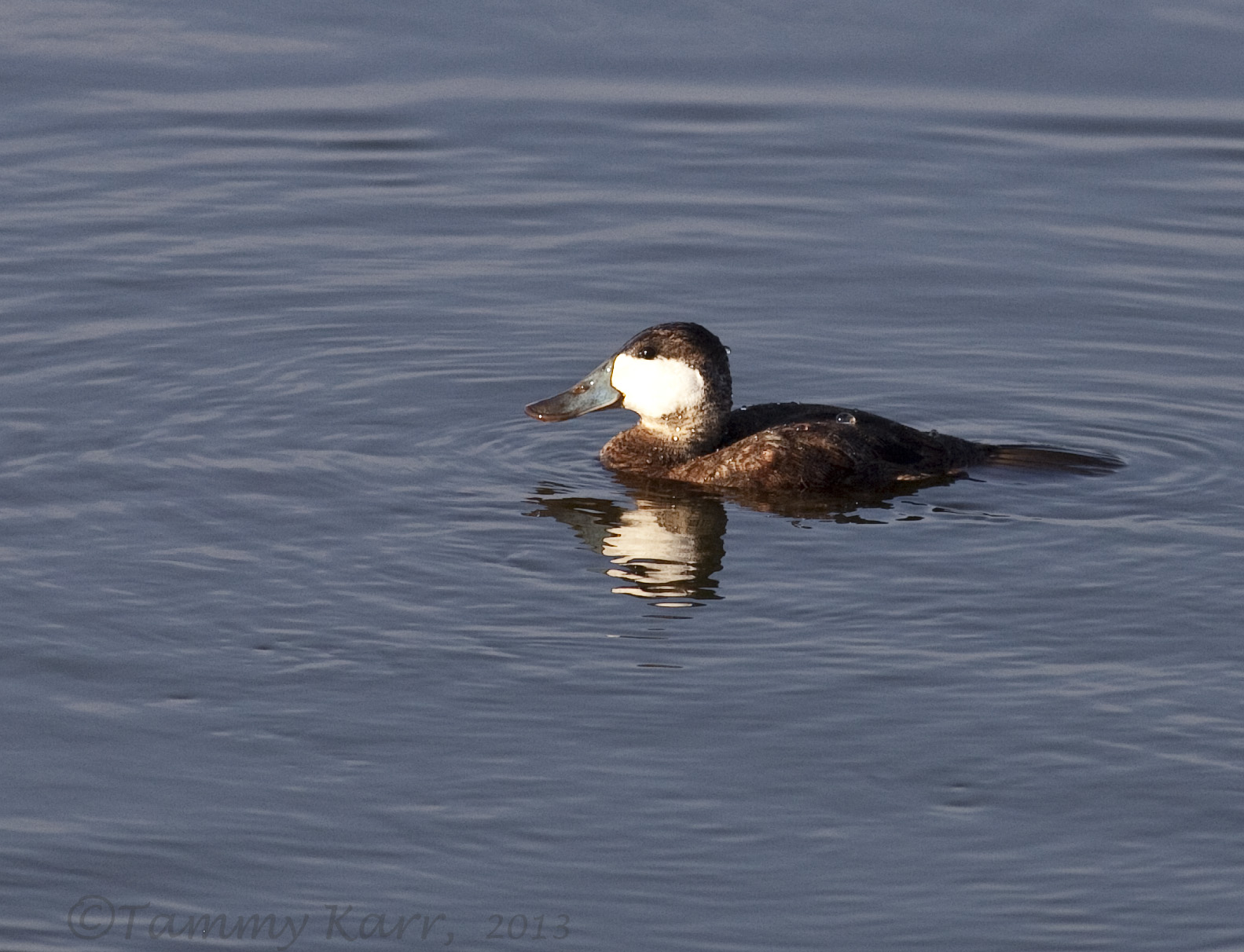
male Ruddy Duck

Ring-necked Duck

American Wigeon pair & Coot

Killdeer

The lower water levels have attracted some long legged friends.

Black-necked Stilt & Lesser Yellowlegs

Thanks to this Stilt I was able to see just how shallow these ponds are.


There was even a pair of Bonaparte's Gulls hanging around. They seemed to be struggling to "fit in". They first to try to join this group of ducks, but that didn't go so well. Where did everyone go? Was it something we said??

Bonaparte's Gulls

The gulls thought maybe they would fit in better with the pelicans.


Many species are now displaying their breeding plumage.

Great Egret in breeding plumage

Tricolored Heron in breeding plumage

Anhinga in breeding plumage